

Dopamine Is Not Why Kids Love Social Media
+ YouTube Shorts rizz party, Clavicular's Club Stream, heat islands, MrBeast's Japan pivot, Costco's chocolate bunny, Twitch streaming as a dog, and the doomed project to cancel Hasan Piker
Amidst the moral panic about social media that’s leading to incredibly dangerous censorship and surveillance laws, the media continues to make outrageous claims about “dopamine.” The Guardian has called for mass online ID verification to break kids out of “social media ‘dopamine loops,’” and outlets like The New York Times have published bogus pseudoscience comparing social media to cigarettes.
As every top free speech lawyer in the country and the writer Peter Suderman has noted, “tobacco is a chemical that is ingested into the body with specific, measurable, physical effects. Social media is a delivery system for speech—speech that will be different for every user, and speech that is protected by the First Amendment because, well, it’s speech.”
My former Atlantic colleague Derek Thompson wrote similarly last week explaining that, social media “isn’t a toxin that we can isolate and test and ban. It is an information-delivery system — a relentless, inescapable IV drip of news, connection, outrage, friendship, conspiracy, solidarity, and garbage — whose effect on any individual depends entirely on what’s in the drip.”
The New York Times Opinion section also ran a piece attempting to make this distinction. Titled, Don’t Cheer Too Hard for the Facebook Verdicts, they write, “a social media site isn’t a bottle of alcohol or a cigarette. It’s not delivering a drug. It’s delivering speech. Sometimes that speech is silly and harmless. Sometimes it is toxic and harmful. Sometimes it’s educational or inspiring. But it’s all speech, and in America speech traditionally can only be blocked, censored or regulated in the narrowest of circumstances.”
Still, proponents of censorship and mass surveillance laws claim that there’s some magical way social media is providing “dopamine” that makes the content uniquely “addictive” and worthy of mass government censorship.
Christopher J. Ferguson, a psychologist and researcher who studies this topic, wrote about how delusional these claims about dopamine are in a fantastic piece for RealClearInvestigations:
There’s a problem with this scientific-sounding explanation for an alleged explosion in addictive behaviors: It is not supported by science.
Solid research connecting dopamine spikes to drugs and alcohol – that is, the capacity of one chemical to ignite another – has not been shown to occur in similar ways with other behaviors. Drug use is fundamentally and physiologically different from behaviors that do not rely on pharmaceutical effects. This has been confirmed in humans: Technology, such as video games or social media, simply doesn’t influence dopamine receptors the way illicit substances do.
Experts say what we are seeing instead is pseudoscience that appears to legitimize a moral panic about behaviors that trouble certain segments of society. By falling for this pseudoscience, parents and others are at risk of missing more fundamental mental health issues that could be at the root of the obsessive behavior, potentially harming the very children they seek to help.
“Addiction is an important clinical term with a troubled and weighty history,” said Dean Burnett, a neuroscientist and coauthor of a brief explainer of what dopamine does and doesn’t do. “People enduring genuine addiction struggle to be taken seriously or viewed sympathetically at the best of times, so to apply their very serious condition to much more benign actions like scrolling TikTok makes this worse.”
Burnett likens current narratives about dopamine and technology to “science garnish,” effectively adding a dash of scientific language to nonsense beliefs. “It’s the informational equivalent of sprinkling parsley on a lasagna that’s 90 percent horse offal,” he said. “It may look nicer, but it isn’t.”
The pseudoscience, however, does play a useful role for parents and others who seek to restrict the behaviors they find disturbing. After all, “Don’t do X because it will dangerously rewire the reward circuits of your brain and cause addiction” is more compelling than “Don’t do X because I don’t like it and think you are wasting your time.”
Pete Etchells, a professor of psychology at Bath Spa University in England and author of “Unlocked: The Real Science of Screen Time,” says research doesn’t support the claim that dopamine drives addiction in other pleasurable behaviors that don’t rely on pharmaceutical effects.
“The role that it plays is really complex, to the point that neuroscientists no longer really consider it the sole or universal factor to consider,” he said. “So, when we try to say dopamine ‘surge’ = pleasure surge = addiction, that doesn’t really hold up under scrutiny.”
You can read the full piece here. I think of a conversation I had with a safety researcher a couple weeks ago, who said that she thinks the entire framing of “dopamine” is deeply misleading. Using social media is nothing like listening to a pleasurable song or playing with a puppy, she said. Instead, it often causes us stress.
She said that, from what she’s seen, social media causes frequent cortisol spikes (sorry Clavicular!) which keep people engaged. This isn’t because of some harmful “design feature,” it’s because much of the information users confront online is stressful, and so they have a stress response. This is very different than the “dopamine” narrative that many grifters are pushing. I’d love to speak to anyone else doing work in this area.
Ari Cohn and Tyler Tone, also highlighted a really good thread over on Bluesky, where a user named lizardky.bsky.social basically asked the question, (as Ari and Tyler summarized): Wouldn’t a platform like Bluesky, where there is no content-recommendation algorithm and users can tailor their feeds to contain precisely the people and types of posts they want to see, even more addictive?
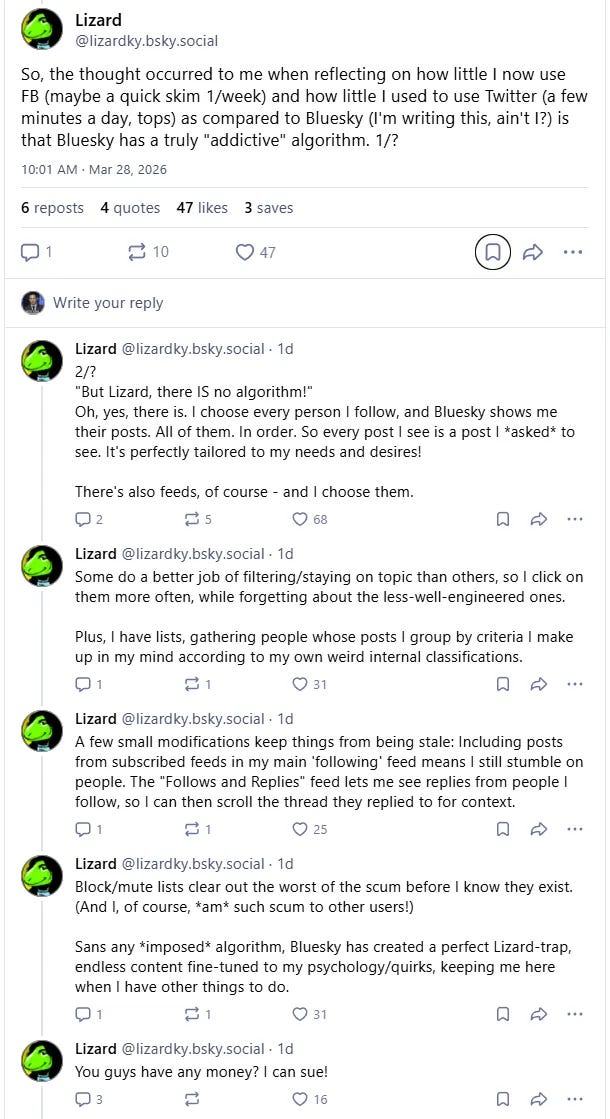
As Cohn and Tone write, “it seems clear that the actual complaint is: the specific content being delivered by the content-recommendation algorithms is the source of the harm.”
Of course, that’s the entire goal of these “social media addiction” lawsuits. We know that those pursuing them aren’t actually interested in changing the design of social media, their goal is to censor “harmful content.”
We know this in part because minutes after the verdict was announced in L.A., the parents of “social media victims” held a press conference. At that press conference, they didn’t mention a single thing about laws that would alter “design features.” Instead, they immediately began advocating for mass online ID verification, repealing Section 230, and passing the Kids Online Safety Act with a strong “duty of care.” All three of these policy proposals would lead to mass censorship and surveillance, and none of them would do anything to change the alleged “addictive design” of the platforms.
Cindy Cohn, former director of the EFF for 30 years, who has a great new book out called Privacy’s Defender, went on The Daily Show last night and attempted to explain these issues to Jon Stewart. He didn’t seem to really get it, and the audience clapped and cheered when the “social media addiction” verdict was mentioned, but she did her best and it’s worth a watch!

Protect your data with Proton
Big tech scans your emails, documents and photos, and uses that data to do things like train AI, profile you and sell your information to advertisers.
Proton Mail is end-to-end encrypted email, which means your email content can’t be scanned. There’s no email trackers to tell senders and advertisers what you read and click on.
Proton Drive is the same principle applied to your files. You can securely store things like tax documents, family photos, sensitive files, because even the file metadata is encrypted.
Sometimes it feels like big tech is tracking us everywhere we go, but you don’t have to move to the woods and go off grid to escape.
Proton brings secure email and private cloud storage together in one simple subscription. Take control and protect your data!
Sign up for Proton today for FREE! 👈👈👈