

My Journey Into The Slop Factory
Higgsfield AI promises to turn you into an AI filmmaker, what it really makes you is a subscriber.
This article is unlocked courtesy of Air, a creative command center for photo and video work. (I’ve used Air for years and I love the platform!!! Air had no editorial oversight or input on this piece.)
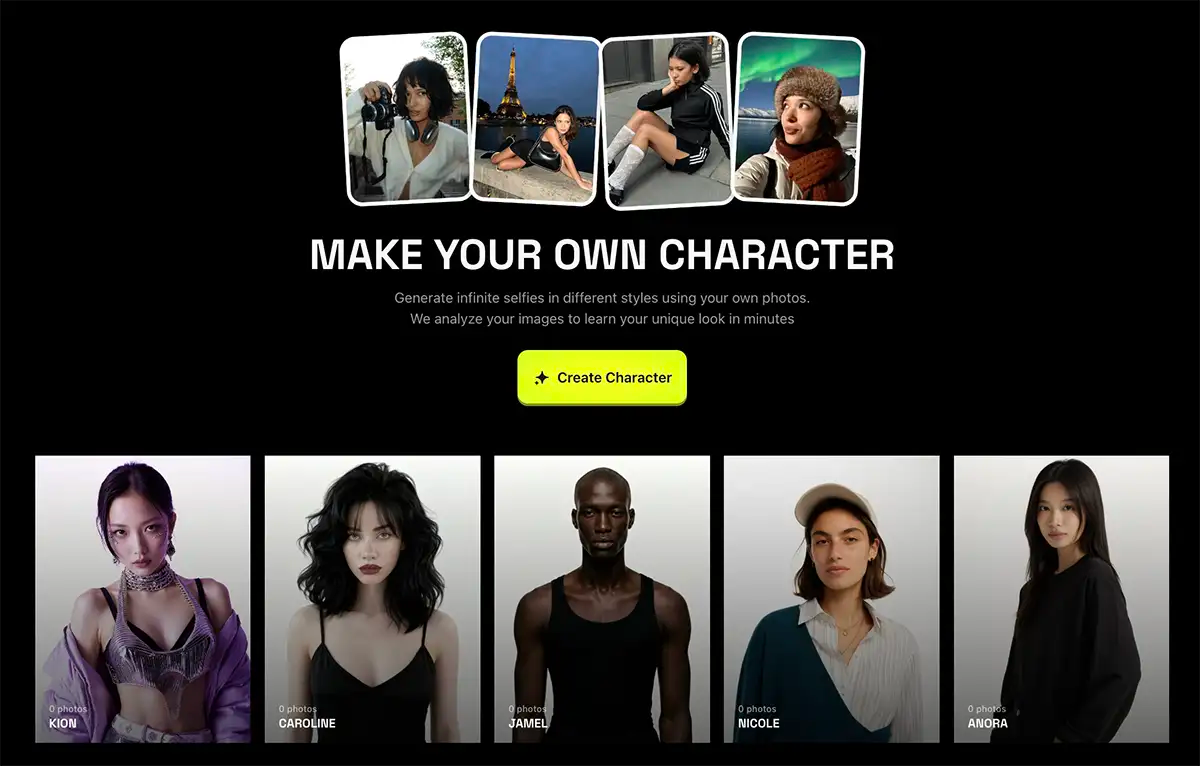
There is a particular kind of video that has plagued my timeline for the last eighteen months. It could best be described as AI slop, but it’s not quite AI slop. A human created it and often these videos feature real human creators, but they’ve been heavily warped by AI. It’s a fashion influencer levitating in the middle of a street or a guy walking across the wing of an airplane, a woman laughing while her small dog explodes into a cloud of confetti.
These videos consistently go viral because of their shocking visuals and seemingly Zach King-level editing magic, but when you scroll to the caption you’ll notice something else: nearly every single one is selling an AI tool.
The generative video AI category which includes platforms like Higgsfield, Runway, Luma, OpenArt, Artlist, Freepik, ByteDance’s Seedance, Soup Video, the now-dead Sora, has spent two years pitching itself as the death of Hollywood. “Within a year, [AI] will be how films get made at every major studio, every production house, and every marketing team on the planet,” the CEO of Higgsfield posted on X in April.
These lofty promises have been supported by a tsunami of viral content online and have allowed companies in this category to raise an extraordinary amount of venture capital.
Runway has raised $860 million across seven rounds since 2018 and was most recently valued at $5.3 billion in February 2026. Luma AI closed a $900 million Series C in November 2025 at a $4 billion valuation. Higgsfield itself has raised roughly $138 million since 2023, most recently at a $1.3 billion valuation, and Pika Labs has pulled in about $135 million across six rounds. According to Crunchbase, global funding for AI-related video companies hit $3.08 billion in 2025, up 94.6% from the year before.
But as these products have expanded, backlash to them has too. “Your AI slop bores me,” Instagram user Matsvandergraaf commented below one video of a content creator using AI to change the background of a scene filmed in his bedroom. But slop discourse is running dry. AI slop has almost become an artform in itself, with its own unique visual tropes, aesthetics, and characters. And some real filmmakers and creators are making some very impressive videos seemingly leveraging these tools, while underlying models are improving.
The problem is that for average users, small business owners, or marketers seeking to leverage these tools, the promises and hype never match reality. These tools, which claim to allow users to generate Hollywood-level videos with a single prompt and a few clicks of a button, are selling a fantasy aimed at boosting inflated metrics to promote an extremely expensive product.
Inside the Higgsfield hype machine
Higgsfield is, by its own telling, the fastest-growing AI startup in history. The company claimed it doubled its annualized revenue run rate to $200 million in just two weeks, and by early February 2026, its annual revenue run rate crossed $300 million. The company says it serves over 20 million users who have created more than 50 million videos. Its CEO has stated publicly that he expects to hit $1B in run-rate by year-end.
But in February 2026, Forbes published an investigation that revealed a darker side. Reporting found that creators recruited to promote Higgsfield received marketing kits that included clips that weren’t AI generated at all. Instead, they were video templates that appeared to have been lifted from a stock site called Envato, which Higgsfield pasted its own logos on top of. Creators also allegedly received Google Drive folders filled with racist and obscene videos and nonconsensual deepfakes of public figures like Sydney Sweeney, Zendaya and President Trump.
Higgsfield’s co-founder told Forbes, “We fully admit that we push the envelope. We learn from what works on platforms like X, and very explicitly, it’s more controversial content that gets attention.”
Outrage-bait marketing aside, my fundamental issue is with the product itself. They basically seek to charge you hundreds of dollars before you even begin. Even if you pay for the lowest tier, you’re immediately hit with prompts to upgrade or limits placed on what content you can actually generate.
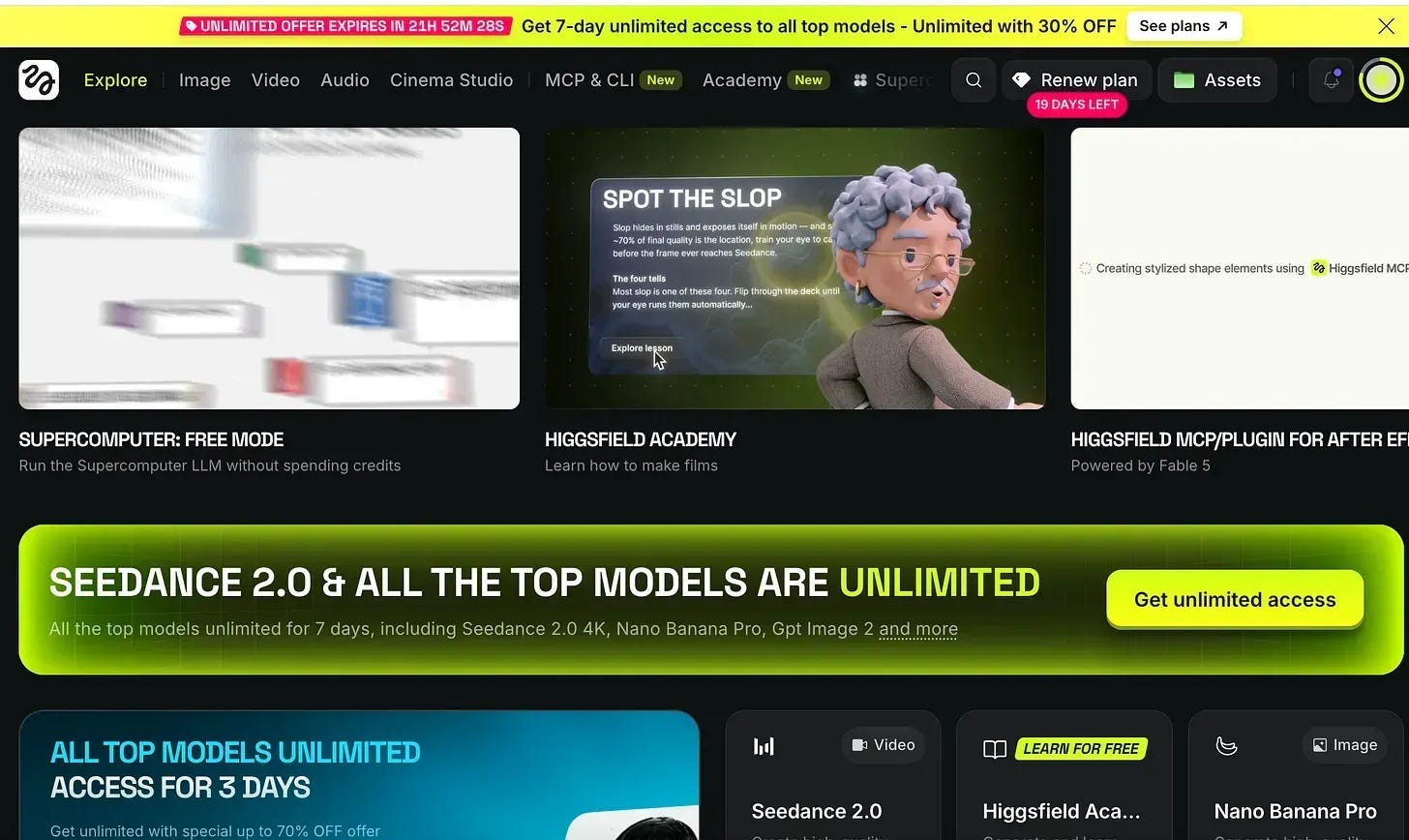
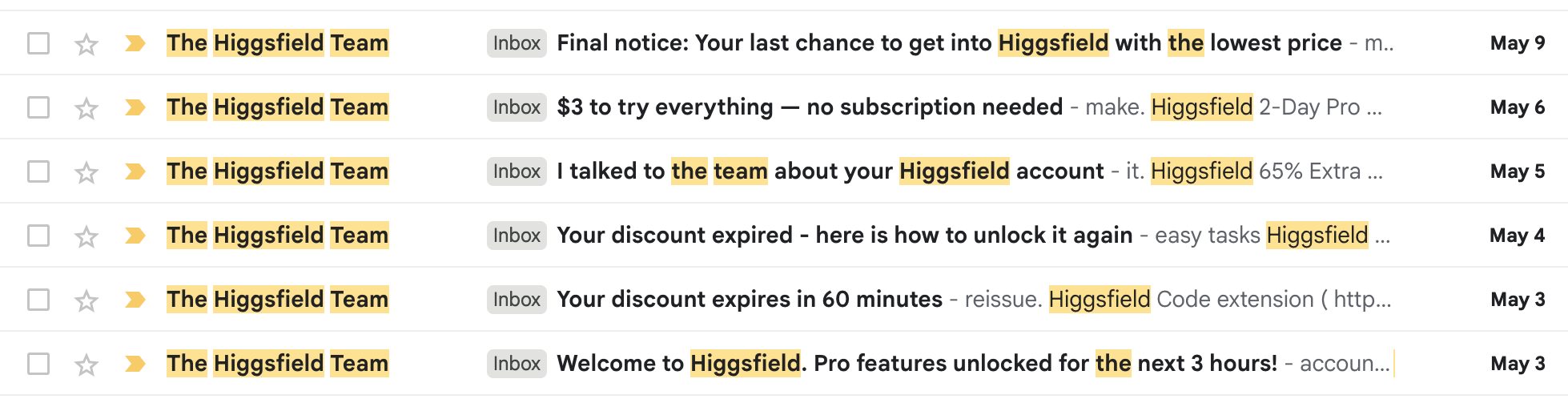
When I signed up for Higgsfield I was bombarded with ads encouraging me to commit to a 55% OFF LIMITED OFFER on Ultimate & Creator Plans. I considered doing the $70 per month aimed at creators, until I read the fine print saying it would be billed annually. That’s $840! I decided to just get into the tool and play around, but I was blocked again. I clicked into the UGC studio and was immediately hit with the prompt: YOU’RE IN 5% WHO RECEIVED THIS PERSONAL 55% OFF WITH NANO BANANA 2 & PRO UNLIMITED & Kling 3.0 UNLIMITED. I tried the page from several other browsers on multiple devices and received the same offer. Immediately, Higgsfield began spamming me with emails saying I needed to act now or my “offer” would expire in three hours.
While Air, the creative services platform I’m partnered with, agreed to cover the cost of my AI video tools, before shelling out nearly $1,000 I decided to investigate the company’s reviews and hear what people who had paid for plans had to say. Multiple users who bought Higgsfield’s “unlimited” subscription tier told Forbes that after generating a few videos in a day, processing speeds slowed to a crawl, with the platform effectively unusable unless you bought more credits. I experienced similar wait times and slow processing speeds, but it’s hard to know how fast these AI tools should generate content at this point.
Reviews on product review website Trustpilot validated this pattern. A slew of users complained that Higgsfield’s “unlimited” tier stops being unlimited within days of paying, and that it’s almost impossible to easily cancel once you’re being charged.
All of this is infuriating to regular users who want to experiment with AI video generation, but end up paying hundreds of dollars and feeling dejected after not being able to create videos like they’re seeing on their For You page all day.
Jake In Motion, a motion designer in Denver, posted a video in April eviscerating Higgsfield’s tools, explaining that average users would have no way of recreating most of the viral social media content promoted by the company, because they have the requisite knowledge actual motion designers have. “It comes down to animation principles,” he commented below the video. “Without knowing why good motion works, you can’t direct any tool, AI or otherwise, to create it.”

After a wave of backlash, Higgsfield’s CEO posted a statement on his personal account saying the team had simply made mistakes while scaling fast. The issue is that the underlying foundation of paid hype and dark-pattern subscriptions and seemingly throttled “unlimited” plans seems to be their entire growth strategy, and consumers suffer for it.
Higgsfield’s playbook is indicative of a broader pattern that’s been building since early 2025, which I will call the Cluely-fication of consumer AI. Cluely, the “cheat on everything” startup, pioneered this practice of leveraging online attention in Silicon Valley. That mass consumer interest generated by the viral content is meant to fuel aggressive growth as people download the app to see if it will live up to the hype. Then, they’re bombarded with aggressive marketing, baiting them to sign up for expensive recurring payment plans. By the time consumers realize the hype doesn’t live up to reality, it’s too late. The high download numbers and revenue stats inflated by new sign ups are subsequently touted in the media as a sign of the product’s success.
Cluely’s founder eventually admitted that he deliberately lied about his company’s revenue numbers. But the same pattern applies, in less brazen form, across this whole AI tools wave. For instance, a $200 million ARR sounds impressive. But if this “revenue” consists of annual prepayments obtained through aggressive marketing from users who will leave at the first opportunity, it is not actually recurring revenue in the classical sense. It’s functionally a one-time cash grab. Churn in these types of businesses can be 80-90% after the first year, but by then, the company has used its big numbers and virality to lure in more customers.
Many of these AI video generation apps also make cancellation deliberately hard. For instance, instead of a “Cancel” button, users will be presented with a “Downgrade to Basic” button. Users on Trustpilot and the Better Business Bureau have vented about the money and marketing budget they wasted on the tool.
“When I subscribed to the ‘Creator Plan’ in November for a staggering $1,000, key features such as ‘Access to all models’ and an ‘Unlimited Video Model’ were explicitly guaranteed as core parts of my contract,” one review reads. “Today, I have to realize that these promises are being systematically devalued. New models like Seedance 2.0 are being withheld from existing subscribers and locked behind new, additional paywalls. Furthermore, the ‘Unlimited Video Model’ promised in my plan has been effectively deactivated and is no longer usable. When I contact support about this, I am simply told that the feature is ‘currently not available’.”
Another user who attempted to use the tool to create content for commercial ad work for clients hit a wall immediately. “The moment you generate a single test output to see if the product works, you forfeit your right to a refund,” he wrote. “It’s specifically designed so the refund window is technically advertised but practically impossible to use, because you cannot evaluate a generative AI tool without generating anything.”
Please stop asking me to upgrade
These testimonials across the web matched my own experience. I effectively couldn’t generate anything without paying and paying and paying. After buying the Higgsfield Ultra plan, for $129 per month, I was immediately flooded with offers to upgrade. I encountered no less than five upgrade ads and prompts before even being able to step foot into the platform and start creating my first AI video.
Once I was in, the platform kept spamming me to purchase the SECRET ULTRA PLAN ADD-ON. The add-on offered a slew of extra options that I wasn’t sure I’d even need since I hadn’t been able to generate even my first prompt. Yet the platform kept pushing to charge me a few hundred extra dollars for things like “50 FREE gens on Kling Motion Control 2.6, up to 10s”. I clicked “skip monthly offer” and another pop up blocked my screen reading, “SAVE $541 AND GET 2X BETTER RESULTS WITH ULTRA MONTHLY ADD-ON.”
Finally, I was able to temporarily prevent the add-on offers from dominating my screen. I decided to start off with something easy. I’d seen a viral trend going around social media of people using AI video editing tools to generate a fan cam style video of themselves at a sports game. It was Higgsfield’s top trending format, and seemed to just require you to upload a video of your face.
I uploaded half a dozen images of myself, waiting about 10 minutes until finally the video was ready. It was an eight second video clip of a woman in a sports stand looking out into the distance. The woman generated by Higgsfield had a slight resemblance to me. She could have been a distant cousin. But it did not look like me.

I went into the prompt box to try to fix things. “Make it look more like me. My face does not look like that,” I typed, then hit “regenerate.” It wouldn’t regenerate without a reference video. I tried to upload the video Higgsfield had just created. It wouldn’t let me, saying the video specs were wrong. I uploaded a different video of myself that I recorded on my phone. I got an error message reading, “Media height of 3840 pixels is too high. Maximum height is 2160 pixels.” In other words, Higgsfield wouldn’t let me edit a video that was recorded in the default format of my phone.
I cropped the video using CapCut and tried again. I received the error message two more times before it finally uploaded after being cropped into a square. I typed again, “Make the video you generated of me in the sports stand look more like me. My face does not look like that.” I smashed the “regenerate” button. Again, the platform generated a video of… someone. The woman had a giant combover and less makeup this time, but was very clearly not me.

At this point I started to try to edit other videos of mine. I tried adding puppies to a fit check video I did (a trend that went viral shortly after Nano Banana first released). The results were bizarre and uncanny. I couldn’t imagine actually posting this stuff!?
You can’t edit an AI video, you can only make a new one
My biggest frustration with AI video generation is something I’ve heard many in the creative world talk about before, basically there is basically zero ways to tweak an AI video. Each time you attempt to tweak something, you’re effectively generating an entirely new video. After several prompts you might fix your original problem with the video, but in the meantime your new generations have created a zillion other problems. The entire experience makes me wonder how many of these tools’ annual revenue is simply generated by users who can’t figure out how to cancel.
The App Store has been a casino of dark-pattern subscriptions for a decade, and we all know to expect these kinds of tricks in something like a Facebook mobile game, but now, dark pattern and deceptive marketing is being leveraged by mainstream consumer AI products that are being pitched to enterprise buyers.
Aside from the shady upselling that’s rampant among these products, there’s also the fact that a lot of what seems possible to create with them, isn’t actually possible. So many viral videos claim that just one or two prompts will get you an award-worthy finished product, and that’s just not true.
Almost every clip you see online promoting one of these AI tools is likely the result of dozens, if not hundreds, of generations. Often this footage has also been tweaked further, color graded, and features expert sound design. Average users have no chance of replicating these results, at least not without burning through thousands of dollars worth of tokens on these products.
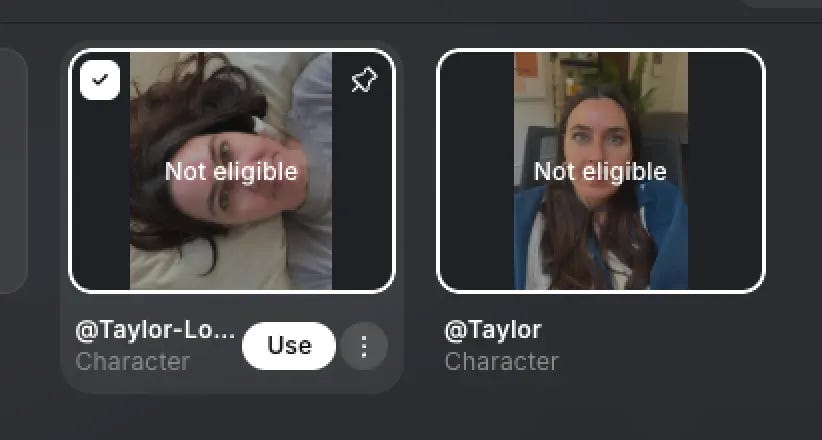
By the end of my experiment, after I eventually successfully uploaded footage of myself, Higgsfield blocked me from turning myself into a “character” that I could insert into AI videos. This apparently has to do with deepfake or IP protections, however there was no way to verify my identity and prove that I actually am Taylor Lorenz and have permission to make these videos, so I just gave up. I’d used 79% of my credits at that point to make about two dozen videos that Grok could probably generate for free.
I decided to cancel. After clicking through five promotional offers aimed at getting me to stay, I was successful. My main takeaway from the whole Higgsfield experience was that until these products become truly consumer friendly, they’re simply not worth it. I think that if these generative AI tools really are the future of content creation, then they shouldn’t have to rely on so much hype and predatory pricing to convince people.

For more great content follow my meme page, subscribe to my YouTube channel, and join my Instagram broadcast channel where I share links all week long.
Listen to my podcast Power User on Apple Podcasts:
Or follow Power User on Spotify:
Great work! I found this really interesting and frustrating how scammy this company seems to be.
As an aside I really appreciate this work you've been doing and I completely understand using AI tools. You have to use them if you're going to discuss them and criticize them. Otherwise you're not talking from a place of knowledge but from opinion, without the facts behind it.
Keep up the fantastic work and I'm happy to be a founding member!
Speaking of AI tools! I know links in the chat can be annoying but I reallllyyyy think some readers might find this interesting. Basically built a platform to interactively visualize the vibes and takes across a variety of topics and dimensions. It's fun and let's you see how takes differ across, eg, millennials vs boomers, parents vs non-parents, urbans vs rurals, etc. Even how User Mag readers compare to readers of other publications. Check it out if of interest: https://votto.app/usermag
Also lets you generate a cool AI synthesis of the throughlines across your own takes after enough responses. Thought some here might find it interesting to explore. Questions span a wide variety of formats, from serios & policy-oriented to light & playful.