

Would you pee on a Flock camera for $50?
Gen-Z sugar mamas, OpenAI’s smart doughnut, Apple's lookalike contest, the AI Scarlet Letter, baby’s first surveillance system, Dario's YouTube habit, and why friend group accounts are trending
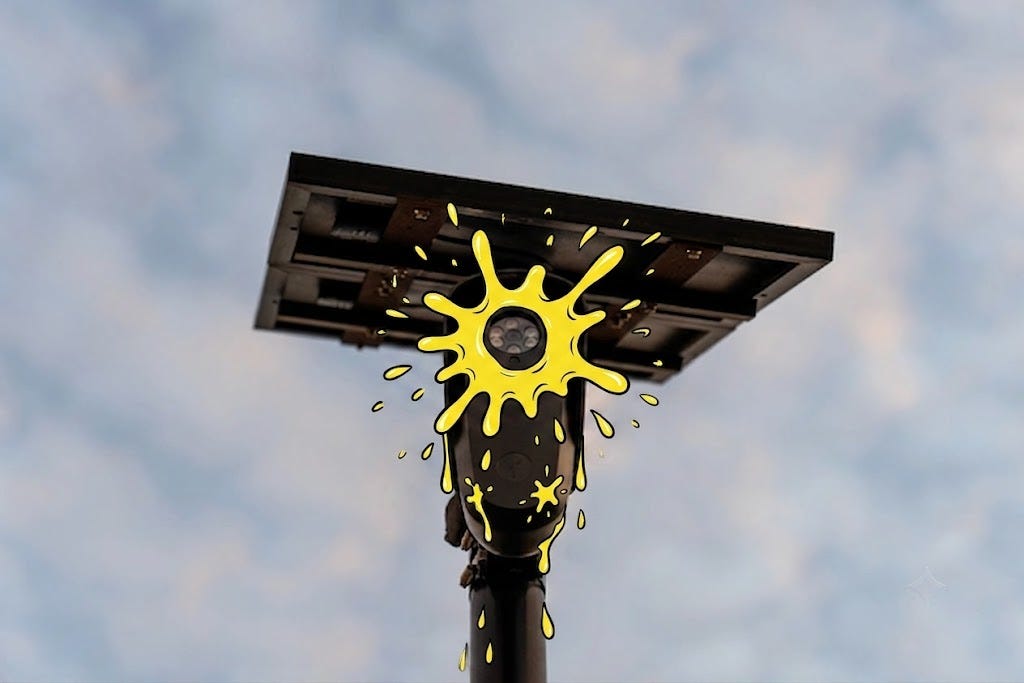
Over the past several months, Flock Safety, the company that makes those cameras you might’ve noticed all over street poles in your town, has been in hot water. The $7.5 billion startup currently operates camera systems in thousands of cities recording millions of people. Finally, after years of outcry from privacy activists, the public has begun to realize that we are living in a mass surveillance hellscape.
There are good reasons to be angry at Flock. Flock’s system allegedly let ICE agents access license plate data that local police departments had collected. The company couldn’t give the LAPD clear answers on who actually owns the data collected by its cameras. One Flock employee falsely told a Wisconsin city council the cameras couldn’t track where a car had been over time when they actually can. A Milwaukee police officer secretly used Flock to track his romantic partner’s location 124 times and her ex’s location 55 times. The detective assigned to investigate that officer was later found to be misusing Flock himself (!!), including planting a GPS tracker on someone’s car. Officers in at least 12 different states have been accused of misusing Flock data, often to track people they had personal relationships with. And, horrifyingly, one Texas sheriff’s deputy searched 83,000 Flock cameras across multiple states, to hunt down a woman who had an abortion.
But as anti-surveillance content has become more popular, it has also become a boon for grifters and right wing influencers exploiting the public’s legitimate anger at the rapid expansion of video surveillance in order to amass views and money.
Take the account Right Now Views. Last year, the account was praising Charlie Kirk, attacking progressive activists, and promoting anti-immigrant slop. But in June, it pivoted. Suddenly, the page began talking about mass surveillance. “FLOCK CAMERAS are quietly logging your ordinary daily errands into a centralized digital trail 🚗💨,” the account’s admin posted. “A massive wave of lawsuits is hitting businesses across California for deploying these advanced tracking networks without posting legally required data policies. While businesses claim it’s just for catching crime and finding stolen cars, privacy advocates are warning about a permanent corporate dragnet tracking law-abiding citizens.”
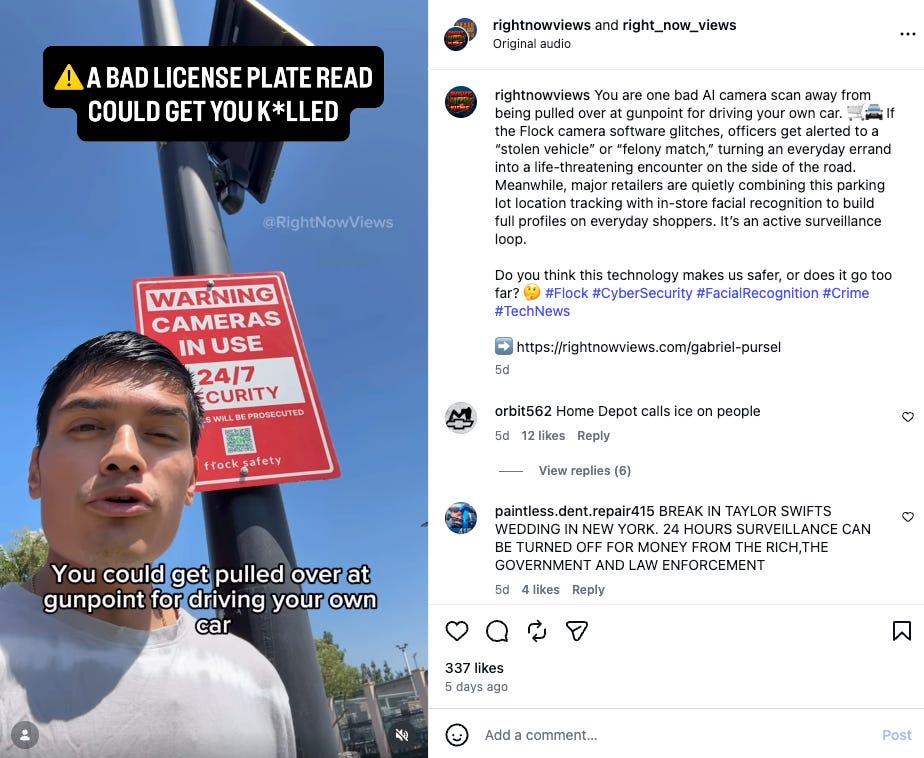
While the assertion is correct, Right Now Views is just one of dozens of far right creators who have begun capturing progressive audiences by creating content about Flock. Networks of influencers on X and notorious right wing YouTuber Tyler Oliveria also hopped on the trend. Last week, he published a video titled “I Exposed Flock: America’s Mass-Surveillance Dystopia” that amassed millions of views.
Flock, and other surveillance companies like their primary competitor Axon, are undeniably profiting off of mass surveillance, but these right wing influencers don’t actually care about that. They see anti-Flock content is trending, and they hop on board. They’re not advocating for privacy laws, they’re not seeking to defund the police (who continue to abuse these camera systems), they’re not backing any organizations like the EFF or the Surveillance Technology Oversight Project, who have spent years fighting against invasive camera systems.
Non-profit privacy organizations and the journalists who report on these topics (I cover Flock constantly on my Free Speech Friday podcast and livestream!) are barely scraping by. These influencers. meanwhile, generate outrage and money, usually by pushing misleading information.
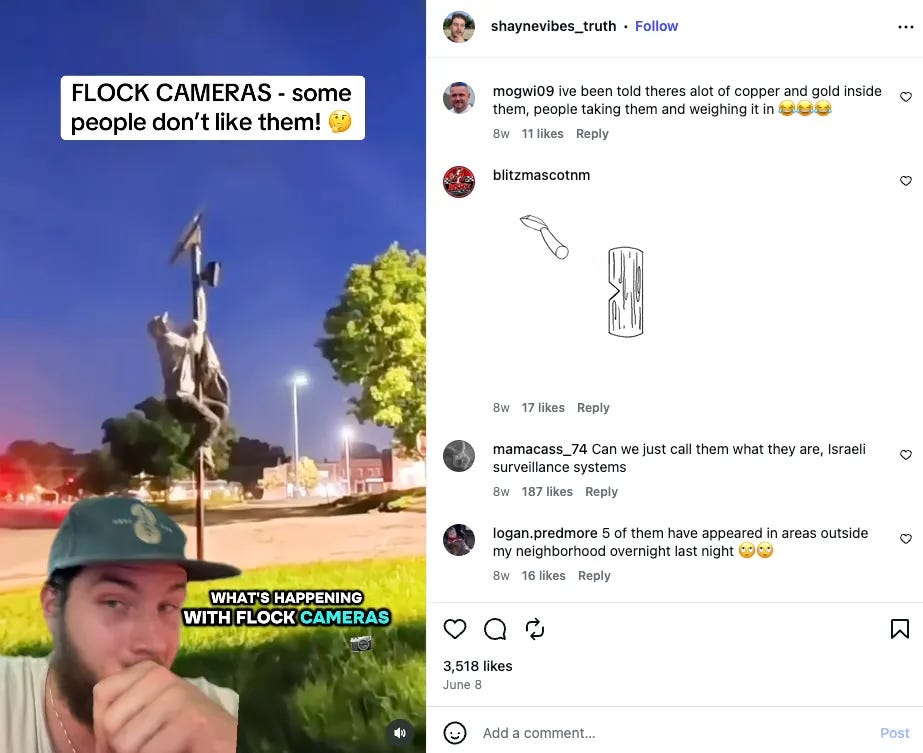
Many of them cosplay as journalists doing on the ground reporting and some are even pretending to be persecuted by Flock Safety itself in an effort to solicit more views and money from their audiences.
As 404 media recently reported, a slew of influencers have begun posting fake cease-and-desist letters from Flock in an effort to make it seem like the company is after them for their “hard hitting” coverage. In reality, these creators have never even interacted with the company. It’s all a grift where they cosplay journalistic persecution for views.
Former American Idol contestant and Instagram influencer Noah Orion, for example, has posted the same fake cease-and-desist letter from Flock to his Instagram account 16 separate times. He is also now posting videos of himself peeing on the ground next to the Flock cameras.

A week ago, he began offering his fans $50 to directly vandalize Flock cameras. “Day one of Venmoing my fans $50 for the first person that goes and fucks up a Flock camera,” he posted. And, he has begun raising money for a “bail fund” since he claims he’s in danger of arrest for his Flock videos.
Orion is just one of dozens of influencers who have amassed tens of thousands of new followers in the past few months from creating anti-Flock content. Some are also selling anti-Flock stickers and merch.
While it’s tempting to see this as a good thing (we love the public turning against mass surveillance!!), what these influencers are doing is ultimately harmful. They are leveraging the public’s very real anger over these systems and channeling it into profit and social media views instead of action. Many are also doing blatant audience capture for the far right.
The irony is that this influencer gold rush actually makes it harder to hold Flock accountable. It becomes incredibly easy for Flock’s PR team to convince a city council that the backlash to the company is illegitimate and nonsense when the loudest voices online are offering cash bounties for vandalism. (Just FYI, Flock gets paid every time one of their cameras is ripped down and destroyed. There are plenty of other ways to physically disrupt the cameras’ ability to surveil us that don’t result in Flock getting $$).
Most importantly, these influencers are siphoning away attention and money from the people actually doing the work of fighting surveillance and reporting on it. Nonprofits and us journalists reporting on these issues survive on donations, and lately it’s been harder and harder to get people to fund independent reporting. The result is an incredibly a lopsided ecosystem where the people with the least expertise and the least accountability are shaping the public narrative around surveillance technology, while the rest of us are struggling to compete.
If the goal is to actually dismantle the mass surveillance camera system that cops are constructing, we need a lot more journalism and a lot less outrage slop. Please support my work by buying a paid subscription. And you can support the EFF here.